





Introduction
India, having 11098 km long coastline, has a rich maritime heritage and the earliest maritime evidence date backs to 5000 years.
Archaeological excavations have discovered the oldest man-made dockyard, over 5000 years old, in Lothal. Lothal is one among the prominent cities of the traditional Harappan civilization dating to 2400 BC, located in Gujarat, a crucial western state of India. The Lothal dock is one of the world’s earliest known docks. It connected the city to an ancient trade route between Harappan cities in Sindh and the peninsula of Saurashtra during the times when Kachchh was part of the Arabian Sea.
Lothal is also a significant location in terms of its diversity of culture. Being a port town, Lothal encountered and hosted many traders from different parts of the world and civilizations. Along with trade products, the cultural beliefs and values, ideas and innovative techniques were also transferred through the sea routes, making Lothal the hub of the culture and economy of the world.
In order to showcase India’s rich and diverse maritime heritage, the Ministry of Ports, Shipping and Waterways has envisioned to develop a National Maritime Heritage Complex (NMHC) at Lothal near Ahmedabad. NMHC aims at;
- Preserving and showcasing India’s Maritime Heritage
- Becoming a leading global tourist destination
- Collaborating with Coastal States & UTs
- Becoming a center for international maritime fairs and exhibitions
- Establishing international collaboration and exchange programs
- Establishing as a maritime training and research center
National Maritime Heritage Complex (NMHC) is to be the first of its kind in the country, dedicated to the legacy of maritime heritage of India.
NMHC Masterplan

The 375 Acre Masterplan of NMHC is guided by Harappan Town Planning Principles. The Citadel; situated at the highest elevated point of the site houses the most important buildings. At NMHC, the National Maritime Museum is The Citadel.The Middle Town includes the Central Bagicha and the Lower Town consists of Recreational Theme Parks, Eco resorts and Hotels / Museotel.
NMHC is being developed in a phase wise manner-
Phase 1A (EPC mode)
Phase 1B (EPC mode)
Phase 2 (Land subleasing)
NMHC project components
- NMHC Museum with 14 galleries Gallery 1: Orientation and oceanic oral traditions
- Lighthouse Museum
- Bageecha Complex (A multi-level parking facility)
- Harappan Era town surrounded by open aquatic gallery
- Coastal State Pavilions
- Recreated Lothal City
- 4 theme-based parks
- Monument theme park
- Naval theme park
- Climate change theme park &
- Amusement park
- Nature conservation park etc.
Gallery 2: Harappans: The pioneer seafarers
Gallery 3: Post Harappan trajectories
Gallery 4: India’s contact with the Greco-Roman world
Gallery 5: Special exhibitions gallery
Gallery 6: Evolution of Indian Navy and Indian Coast Guard
Gallery 7: Trade and cultural relations with Southeast Asia and beyond
Gallery 8: Maritime traditions of Gujarat
Gallery 9: Age of emporia contact
Gallery 10: Maratha Naval power
Gallery 11: Arrival of Europeans
Gallery 12: Science, Math, Tech and Children’s gallery
Gallery 13: Traditional shipbuilding and navigation techniques of India
Gallery 14: Indian shipping post-independence
Project progress
At present, the construction of Phase 1A of NMHC is in full swing with physical progress at around 80% is nearing completion.
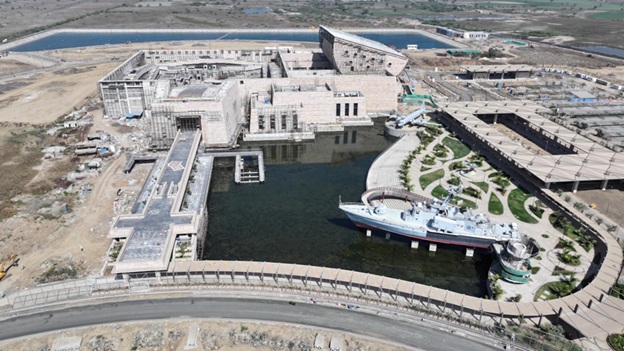
The cabinet approval for the development of remaining phases of NMHC was obtained on 09.10.2024. Accordingly, the Directorate General of Lighthouses and Lightships (DGLL) will be undertaking the development of lighthouse museum at NMHC, and a separate society is constituted under the Chairmanship of Hon’ble Minister of Ports, Shipping and Waterways to undertake the development of remaining phases of NMHC by collecting contributions from government and non- government entities.
Development of Coastal States Pavilion
The Coastal States Pavilion aims to celebrate the diversity of India's coastal heritage, recognize the contributions of coastal communities to the nation’s history, and highlight India’s position as a key maritime nation in the Indian Ocean region. The pavilion will serve both as an educational and cultural space, offering insights into the historical and contemporary importance of the seas and waterways to India’s economy, culture, and security.
The Coastal States Pavilion at NMHC is envisaged to be designed to highlight the maritime traditions, cultures, and histories of India's coastal states, which span the entire length of the Indian Ocean.

The coastal states and UTs may showcase the rich maritime heritage of their respective states and UTs by exhibiting the following items:
- Coastal archaeological sites along with the port towns
- Antiquities like, sculptures, terracotta figurines, coins, paintings, manuscripts, etc. showing the rich maritime traditions
- Monuments/temples/forts and cave sites along with Sculptures/inscriptions
- Communities living in the coast, their culture & traditions
- Boat building technique along with the legacy of shipbuilding
- Trade, Culture & Religious interactions of each state/UT with the foreign nations
- Tracing the continuity of art & craft like Bead making, pottery, textiles, metal work etc.
At present Coastal States/ UTs of Gujarat, Maharashtra, Karnataka, Tamil Nadu, Odisha, Andaman and Nicobar Islands, Puducherry, Lakshadweep and Dadra and Nagar Haveli & Daman and Diu have formally consented the development of their respective Coastal State Pavilion at NMHC.
Development of Tourism Circuit for NMHC
The National Maritime Heritage Complex (NMHC) at Lothal is poised to become a key tourism destination in India, celebrating the country’s rich maritime history. The development of a tourism circuit around the NMHC is an integral part of this vision, aiming to enhance the experience for visitors and make the region a hub for maritime history, culture, and education.
Gujarat maritime tourism circuit
Gujarat, with its long coastline, rich maritime heritage, and key historical port cities, is a perfect location to expand the tourism circuit. The state is home to several maritime landmarks that can be integrated into a cohesive tourism circuit.
Marine & Coastal Ecology: Integrating Nature Tourism
The tourism circuit can emphasize the integration of nature tourism, focusing on the marine ecology and coastal biodiversity of Gujarat and neighboring states.
Cultural and Heritage Integration
The tourism circuit could also focus on cultural and heritage tourism, promoting local crafts, traditional livelihoods, and festivals associated with coastal communities. This may also include Traditional Shipbuilding and Craftsmanship, Coastal Cuisine etc.
Integration with International Maritime Routes
Promoting India’s position in the Indian Ocean and its role in global maritime trade can also be an aspect of the tourism circuit. By highlighting the maritime Silk Road and India’s historical importance as a center of sea-based commerce, the tourism circuit can attract international tourists interested in history, archaeology, and trade.
International collaboration
India, particularly the coastal regions like Gujarat, Maharashtra, Kerala, and Tamil Nadu, had extensive maritime trade connections with various parts of the world in antiquity. Some of the key regions and cultures that had maritime ties with India include:
Mesopotamia (modern-day Iraq): The Harappan Civilization (Indus Valley) traded with Mesopotamia around 2000 BCE through ports like Lothal.
Arabian Peninsula: Ancient seafarers from the Arabian Peninsula, particularly the Sabeans and Hadramites, were active traders with the western coasts of India.
East Africa: Trade routes connected ancient Indian ports like Barygaza (modern-day Bharuch) with East Africa, including the Swahili Coast (modern-day Kenya, Tanzania, and Somalia).
Southeast Asia: India’s maritime influence extended to Southeast Asia, especially Indonesia, Thailand, Cambodia, and Vietnam through cultural exchanges, Buddhism, and trade.
China: Early Indian traders had sea routes to China, especially for silk, spices, and other luxury goods.
Sri Lanka: Maritime exchanges between India and Sri Lanka were well-established, especially with the southern coast of India.
Given the historical maritime connections, several countries and their maritime heritage can contribute to the NMHC project. International collaboration could occur in multiple areas, such as:
- Archaeological Research & Excavations
- Maritime Museums and Exhibitions
- Cultural and Academic Exchange
- Technology and Conservation
- Shipbuilding and Maritime Engineering
- Joint Maritime Studies & Research Centers
Collaboration with archaeological institutes and universities from countries can help conduct joint excavations, research, and documentation of ancient maritime trade routes. Many of the countries also have significant underwater archaeological expertise and could assist in underwater excavations near Lothal and other coastal regions of India.
Countries with a rich maritime history, such as Greece, Egypt, and Italy, could collaborate on curating special exhibitions showcasing ancient trade goods, shipbuilding techniques, and the role of maritime in shaping global civilizations. These nations have vast experience in maritime archaeology, especially undersea exploration.
Institutions from countries South East Asian countries, with significant historical and cultural ties to India’s maritime past, could help create joint educational programs, workshops, and academic research focused on ancient navigation, shipbuilding, and maritime trade. This could also lead to cultural exchange programs showcasing traditional maritime crafts, navigation techniques, and literature.
Incorporating advanced technologies for preservation, digital reconstruction, and virtual reality (VR) experiences can be a key part of the NMHC project. Collaboration with countries like Japan, South Korea, and Other—leaders in digital technologies, conservation techniques, and maritime engineering—could help create immersive, technologically advanced exhibitions.
India’s ancient maritime tradition of shipbuilding, particularly in places like Lothal and the coastal regions of Gujarat, could be revitalized through partnerships with countries like Japan and South Korea, which have a long history of maritime expertise. These collaborations could focus on the construction of replica ships and boats based on ancient designs, showcasing the craftsmanship of ancient shipbuilders.
India could establish a Maritime Research and Innovation Center in collaboration with maritime powers like the UK, Portugal, and the Netherlands, all of whom were integral to the expansion of maritime trade during the colonial period. These centers could focus on the study of ancient navigation, environmental impacts on maritime trade, and sustainable practices for the future.
The NMHC could serve as a global platform for hosting international maritime events, such as:
- Maritime Heritage Festivals
- International Maritime Conferences on sustainable shipping, ancient navigation, and global trade
- Naval and Cultural Exhibitions showcasing maritime history from different countries
This would promote cultural diplomacy, foster international partnerships, and allow countries with shared maritime heritage to engage in dialogue and collaboration.
At present, International Collaboration have been established with the countries of Portugal, UAE, Vietnam, Thailand, Denmark, Netherlands, Oman, Germany, and Israel. Further, the Ministry in coordination with the Ministry of External Affairs have proposed collaboration with the countries of Myanmar, Sri Lanka, Mauritius, Maldives, Iran, Bahrain, Iraq, Egypt, Tanzania, France, Greece, Italy, Norway, Cambodia, Indonesia, Australia, New Zealand, Japan, South Korea, South Africa, Fiji, UK, USA, Yemen, Singapore, Spain,
Constitution of NMHC Society
NMHC is envisaged to be developed by raising funds from voluntary resources/ contributions.
In this regard, the cabinet has provided approval for setting up a separate society, to be governed by the Governing Council headed by the Minister of PSW, under Societies Registration Act, 1860 for implementation, development, management, and operation of NMHC at Lothal, Gujarat. And to authorize the society for development of future phases of NMHC as per Master plan. The NMHC Society was constituted on 09.04.2025