

Overview of Sagarmala Programme
Sagarmala Programme, launched in March 2015, is a flagship initiative of Ministry of Ports, Shipping and Waterways aimed at promoting port-led development in India. With a coastline of about 11,099 km, potentially navigable waterways of 14,500, and a strategic location along major global trade routes, India has significant potential for maritime-led economic growth. The programme seeks to enhance logistics efficiency, reduce transportation costs, and boost trade by promoting greater use of coastal shipping and inland waterways over traditional road and rail transport. Sagarmala focuses on port modernization, new port development, port-linked industrialization, coastal community development, port rail and road connectivity, and skill development, while leveraging public and private investment.
The Programme is aligned with the Maritime Amrit Kaal Vision 2047 (MAKV), which aims to position India as a global maritime leader. MAKV envisages achieving about 4 million gross tonnage (GT) of shipbuilding capacity and handling nearly 10 billion metric tonnes of cargo annually at ports, with the goal of placing India among the top five shipbuilding nations by 2047. Formulated through extensive stakeholder consultations and global benchmarking, MAKV outlines around 300 initiatives to develop world-class ports, expand coastal shipping and inland waterways, and promote the blue economy. Sagarmala Programme supports these objectives by enhancing port infrastructure, improving logistics efficiency, and strengthening coastal and maritime connectivity, thereby contributing to India’s maritime growth by 2047.
The vision of Sagarmala Programme is to reduce logistics costs for both domestic and EXIM cargo through optimal and efficient infrastructure development. Studies undertaken under Sagarmala have identified significant opportunities to lower overall logistics costs, thereby enhancing economic efficiency and improving the global competitiveness of Indian exports.
Current Status of the Sagarmala Programme.
As part of the Sagarmala Programme, around 845 projects, estimated to cost around 6.06 lakh crore, have been identified for implementation. Central ministries, IWAI, Indian Railways, NHAI, State Governments, Major Ports, and other relevant organizations implement these projects. 315 projects have been completed, which account for an investment of approximately 1.56 lakh crore.
Achievements of the Sagarmala Programme.
Over the past eleven years, Sagarmala has significantly advanced port‑led development and coastal connectivity across India. Under the programme, 128 projects worth approximately Rs. 8,938 crore have been funded, of which 78 projects valued at about Rs. 5,357 crore have been completed. This includes 11 fishing harbour projects costing Rs. 1,057 crore, directly benefiting over 30,000 fishermen, and 7 coastal berth projects worth Rs. 494 crore, adding 9.84 MTPA of cargo‑handling capacity.
Sagarmala has also accelerated the growth of urban waterway transport, with 29 Ro‑Pax and passenger ferry projects supported at a total cost of Rs. 1,233 crore. Of these, 17 projects worth Rs. 706 crore have been completed, benefiting more than 35 lakh passengers. Notable successes include the Ghogha–Hazira Ro‑Pax service, which reduced travel time from 10 hours by road to just 4 hours by sea, enabling the movement of 36,000+ trucks, 61,000 cars, and nearly four lakh passengers. Similarly, the Mumbai–Mandwa ferry has eased congestion by replacing a 109 km road journey with an 18.5 km sea route, substantially reducing travel time.
Under the DDU‑GKY convergence initiative, Sagarmala has strengthened coastal livelihoods by training over 7,600 candidates, with more than 3,100 successfully placed in maritime and allied sectors.
New additions to the Sagarmala Programme: Sagarmala 2.0.
Sagarmala 2.0 builds upon the progress of the original Sagarmala Scheme (2012–2025) with an expanded national vision. Its key objectives include supporting India’s ambition of becoming a 30‑trillion‑dollar economy by 2047, advancing the Viksit Bharat Mission through enhanced port capacity and employment generation, and driving the modernization of the maritime sector to strengthen the country's logistics ecosystem. It also aims to safeguard India’s strategic interests, particularly through strengthened coastal and island infrastructure, while promoting sustainable and green practices across maritime operations.
Objectives of the Sagarmala Programme
With a strategic focus on port modernization, connectivity, industrialization, and skill development, the Sagarmala Programme is also unlocking new avenues for economic expansion, positioning India as a global maritime powerhouse. Sagarmala's vision can have a potentially transformative impact on India’s logistics competitiveness and the wider economy.
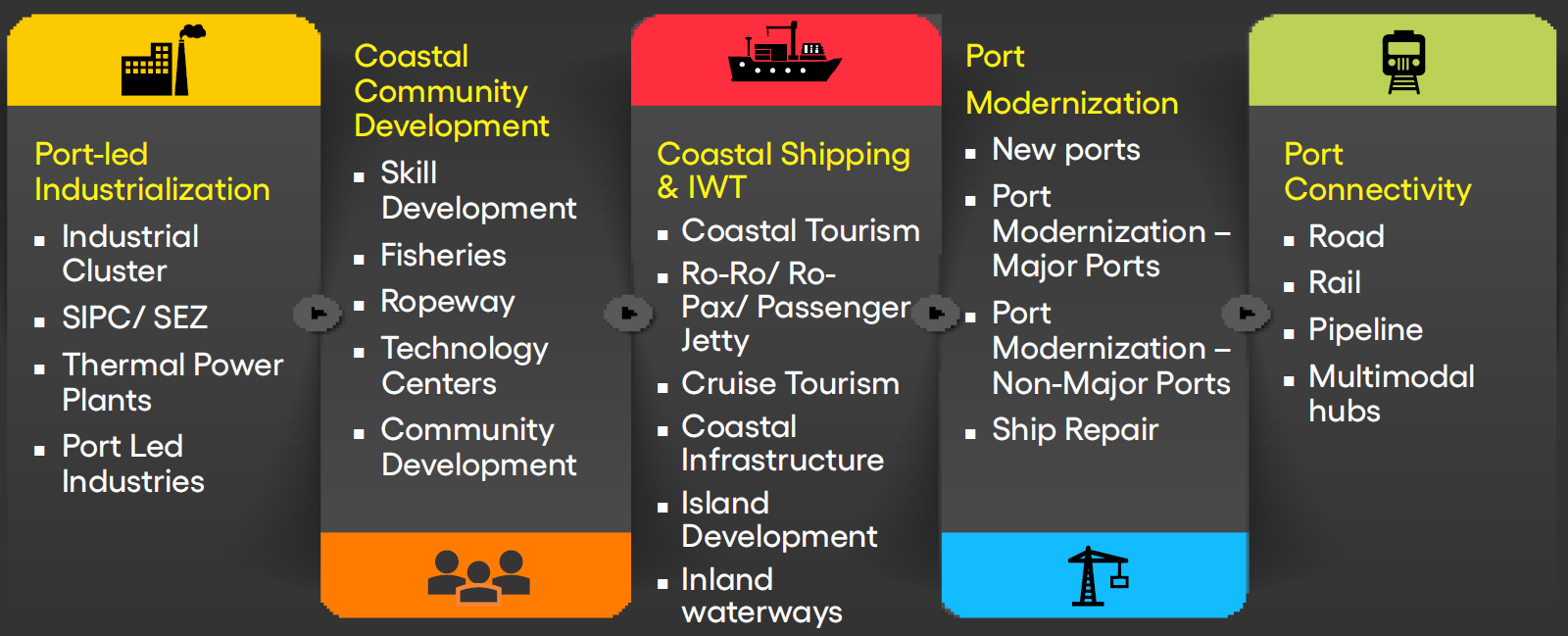
Overall set of projects are divided into 5 pillars and 24 categories